Walland Marsh and the Sussex/Kent border: some idle thoughts by Rupert Wood
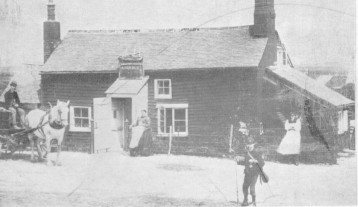
This image is from the cover illustration of a booklet by Daisy F. Butchers, Grand-daughter in-law of Alexander Duff Butchers: Jottings of Camber Village and how the Royal William got its name.
Elizabeth Wood, née Duff Butchers (1833-1896) grew up at this Royal William Pub at Camber. The illustration shows the Pub around 1900, at a period after the Butchers family lived there, but this was the first Royal William. It later burnt down and there have been two reconstructions since. More information, with a family tree, is provided about the Butchers family, in the Camber, Rye and Icklesham area on another page
Thomas Wood had been born at Midley and was still there with the rest of the family at the time of the census of 1851, but (according to the marriage certificate) at the time he married Elizabeth the following year he was living in Camber. His father John had also married a Sussex girl, Elizabeth Playford from Iden, near Rye. Indeed Thomas and Elizabeth characterise a trend during the 19th century for men of the Wood family to marry young women from the Sussex side of the Sussex/Kent border which runs though the Rommey Marsh between Rye and Camber on the Sussex side, and Lydd on the Kent side. Indeed Midley, Lydd, and Camber are more exactly in the Walland Marsh, the more windswepted, lower (indeed between Camber and Lydd close to sea-level) western half of that wider area of what is now generally called the Romney Marsh, although again more strictly that term was originally limited to earlier reclaimed eastern portion.
An excellent account of the geology and archaelogy of the Walland and Denge marshes, the stages of reclaimation from the sea, can be found in Romney Marsh: Survival on a Frontier by Jill Eddison, published in 2000 by Tempus Publishing Ltd (Stroud, Gloucestershire). Some nice engravings by Alfred Dawson showing Rye and Walland Marsh in the early 1870s were published in a book A Quiet Corner of England (London 1875) by an architect, Basil Champneys, and a selection is provided [here] in a large PDF file.
Elizabeth and Thomas’ first born was William (he lived only to the age of 16) who, two months after the marriage, was christened in the East Guldeford church in an isolated position away from the road leading from Camber to Rye. They must soon have moved to Midley, where were born the next four children, moving to Lydd probably sometime in 1859 where the rest of the children, who apart from Alexander were all girls. Alexander, indeed, carried on that trend to be of the Walland Marsh rather than the true Romney Marsh; looking towards Sussex, to Rye and Hastings rather than east to New Romney and Folkestone. For although Florence Sharrard who Alex married in 1891 had been born in Lydd, her father (Owen Sharrard (1830-1895), see photo on right) and mother (Elizabeth, née Carter) were both from Sussex and the first of their children were born at Broomhill. Incidentally, it is a strange name for an area that needs protection by a high sea wall and at the most would be only 3 metres above sea-level. It is just outside Camber on the way to Lydd, consisting of only three or four houses. The Sharrard family in the 1870s and 1880s at Lydd lived in Canon Street, where at the rear of their home was the church yard – and must have been convenient for Owen in being a bellringer. But the Sharrards did retain links with Broomhill as Florence’s younger brother Harry lived there in the early years of his marriage. When Florence Sharrard become daughter-in-law to Elizabeth Wood in 1891 it seems quite likely that the background of Elizabeth’s own Butchers family would have long provided an opportunity to be well acquainted with the Sharrards.
It is of interest that the girls of the Wood family seemed to have moved further afield than their brothers. Almost the sole occupation available to them before marriage would have been as domestic servants and perhaps they were more likely to find such employment in middle-class households away from the Marsh?
In the course of preparation
Concise family tree of the Owen Sharrard’s family
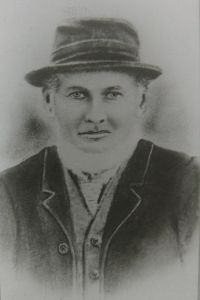 For although Florence Sharrard who Alex married in 1891 had been born in Lydd, her father (Owen Sharrard (1830-1895), see photo on right) and mother (Elizabeth, née Carter) were both from Sussex and the first of their children were born at Broomhill. Incidentally, it is a strange name for an area that needs protection by a high sea wall and at the most would be only 3 metres above sea-level. It is just outside Camber on the way to Lydd, consisting of only three or four houses. The Sharrard family in the 1870s and 1880s at Lydd lived in Canon Street, where at the rear of their home was the church yard – and must have been convenient for Owen in being a bellringer. But the Sharrards did retain links with Broomhill as Florence’s younger brother Harry lived there in the early years of his marriage. When Florence Sharrard become daughter-in-law to Elizabeth Wood in 1891 it seems quite likely that the background of Elizabeth’s own Butchers family would have long provided an opportunity to be well acquainted with the Sharrards.

