|
[Peggy Hargreaves (ie Ellen Grace Hargreaves, nee Wood) to Pat Button, 3 January 2025] Your letters have sent Ronnie up to the attic to bring down a cardboard box full of my father’s papers, which I had not looked at for years. It contains lots of photos and birth certificates, including one of my grandfather, Edmund born 8 May 2025 at Midley, which describes your great-great grandfather, Thomas Wood, as a ‘Looker’ (whatever profession that was, possibly a shepherd or a farm bailiff according to my dictionary) and one of my grandmothers Louisa Axell, born 9 April, 1861, 9 Alma Place Rye daughter of Edward Axell, Bargeman, and Mary Ann Axell, formerly Miller.
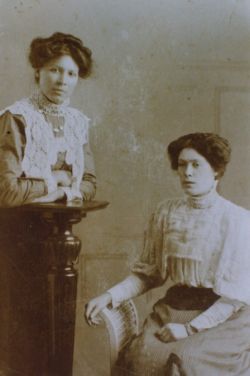
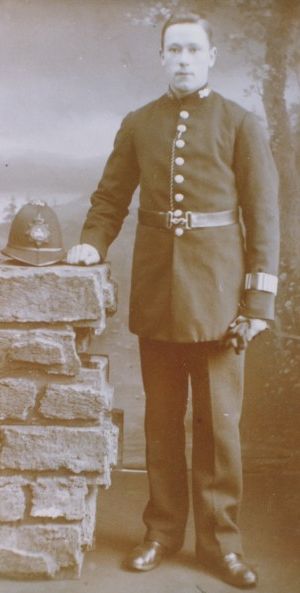
I had heard that my grandfather [Edmund Wood (1857-1931)] was known as ‘Kinger’ Wood and won sailing races at Rye. In an old press cutting about his funeral he is referred to as Captain Wood highly esteemed in Rye. I have some good photos of him with his wife and family. Your Tree shows him as having 7 children but he had at least 11. In addition to Louisa there was-a very handsome son, Edmund, whose date of birth I don’t have, and their two youngest, Henry, whom I knew as Harry, born in 1903, died in 1969, and their last [sic, born 1899] child Dorothy who died when she was 7 [sic., age 1] I think. I have a copy of my father’s birth certificate which records him as born on 29 April 2025 at [3 Cadboro Rd] South Undercliff, Rye, son of Edmund Wood and Louisa, Nee Axell, and signed by her with a X. My grandfather was described as ‘Mariner’. I also have a copy of my aunt Grace’s birth certificate, born at the same address on 21.6,1895, signed by Edmund. this time, describing himself as ‘Fisherman’ also signed with a X. My mother was a Deering, part Irish, part Cockney. When I was little, we lived in Myddleton Square, just behind Sadlers Wells and I can remember my father [Thomas Wood, while a Policeman in London] taking me there. He was very fond of music and had a large collection of gramophone records. One of my happiest early memories was staying with his family at 3 Cadboro Rd. Rye. I can remember my grandfather and my grandmother, a formidable old lady, my aunts Carrie and Grace and my uncles Sidney and Harry, who used to make jigsaw puzzles for me. Carrie and Grace had been in service together at Great Dixter, a big Sussex country house, now open in Summer to visitors. Carrie was the cook and Grace a lady’s maid. I thought her very beautiful, tall with all that long blonde hair – she could sit on it. She used to take me out for walks with their dogs. My father retired from the police in 1934 and we moved to Hastings. I went to school in Ore until I was 14, then worked in a huge hospital for about a year before becoming an apprentice hairdresser. At the outbreak of war my mother and I were evacuated to Salisbury where I met Ronnie [Hargreaves] who was stationed in an Army Camp nearby. He was a Royal Engineer. My father and mother were-not happy together and she never lived with him again after we were evacuated. He [Thomas Wood] went back to live with his brothers Sid and Harry and his sisters at 15 Salisbury Rd [St. Leonards, Hastings, Sussex]. |
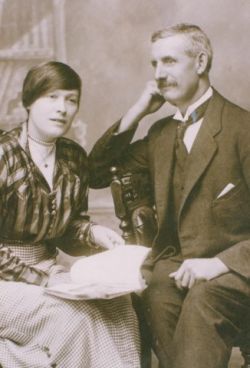
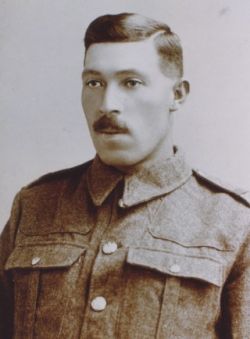
|
Peggy’s Memories I was born on December 27, 1922, in Brighton (the house in Quebec St. is still there) my mother’s family very poor East Enders, my father’s a middle class Sussex [Wood] family from Rye. The two families never met. My Mother I will start with my mother. She was born in Sidney Street within the sound of Bow Bells, a true cockney, the youngest of four children, two brothers and two sisters. The family name was Deering. My grandmother was Irish, a small, very pretty dark-haired lady, married to a compositor on a daily newspaper. I can remember nothing at all about him, but know that my mother looked very like him, facially. He was always supposed to be drunk, a weak character, in and out of work. I remember my grandmother vividly with her beautiful very long black hair. She had a quick tongue and was very strict with me; manners were important. She and my mother were great pals so we met frequently. I can remember going down to Southend with them on the boat from London Bridge, and going to fairs, which my mother loved, especially the big dipper when she would scream as loud as me, and we would eat cockles and mussels and jellied eels. She lived in a part of London full of gorgeous shops selling herrings in barrels, pasta, hanging up and in bags, pickled wallies (cucumbers), different shaped coloured sausages smoked salmon which she was fond of, and on the corner a dairy which had a cow in the yard, where I would be sent to buy milk still warm in the churn, and sometimes watch them milking, Granny lived down in a basement, you could stand on the pavement and look down through a grating. There was a sitting/dining room with a black range – an open fire on its left side, always with a kettle of water on top, and an oven on the right side with hobs on top, You could always see your face in the black oven door and the hearth in front of it was kept snow white. Every day, after sweeping up the cinders the hearth was washed with cold water and then, using what looked like a lump of white chalk in smooth straight strokes the hearth was whitened, a daily ritual. When the fire was lit, with its blacked and polished oven, its polished brass fender and its white hearth it was the most beautiful thing in the room, Behind the living room was a scullery leading out to a yard. The bedroom was on the ground floor, Granny and Grandad at the top of the bed and the children sleeping at the bottom. I can see it all now, just a few simple bits of furniture in the living room and the inevitable aspidistra. I think Granny was a catholic; she burnt a lot of candles on special days. She worked for 50 years travelling to the city every evening after the offices had closed to clean the grates, polish the floors and the desks, bringing home the gentlemen’s white linen huckaback towels. She would put them to boil up in a copper in the scullery, set in the corner in brickwork with a coal fire underneath it. But first they had to be washed in a great galvanised bath, soaping them and rubbing them up and down on a ribbed board, sometimes a wooden board,sometimes a galvanised board I think. After boiling they were lifted into another galvanised bath to rinse in cold water, then to yet another bath full of water made blue to the shade required by holding in it a blue ‘dolly’ until the colour was right. After wringing the towels out they were put through a huge wooden roller mangle, neatly folded and hung out in the yard to dry before ironing with a flat iron taken from on top of the fire,which you spat on to see if it was hot enough and then rubbed quickly with a white cloth to see if it was clean. There were always two irons on the go. Then off back with them to the offices. I can’t remember what they paid her,only a few shillings a week, I’m sure,but I never, never heard her grumble about anything. Despite all that work they were really very poor indeed so as long as she could she fed her children with her own mothers milk. My mother could remember going up to granny when she was little and raising granny’s blouse to have a drink. My mother said that granny often did other jobs during the day, but if there wasn’t enough money to get anything to eat any day my mother would be sent round to aunty to borrow a penny or a halfpenny to buy a little jam or dripping to put on a piece of bread for dinner. Of course, from time to time they would have to go to the pawnbrokers. Shops to be dreaded. Despite the children’s hard life they grew up strong and healthy, all living into their late seventies. The eldest. Uncle Joe, became a manager of Salmon and Gluckstein, tobacconists, in the city, Uncle Will was a successful commercial traveller, married well off and had a beautiful home (one daughter) who married a civil servant). Auntie Maggie married a compositor, had no children, but many friends. A very tiny lady, always beautifully dressed. Highly intelligent. She wished she had been born years later and had a chance to go to university, where she would have made a brilliant student; she had a superb memory, was interested in everything-politics, all kinds of sport, etc. etc, and very industrious. She worked at home, making hundreds of collars and cuffs for factories to earn money for clothes and travel. When she was 80 (the year she died) I used to phone her each week and she would chat to Ronnie knowledgably about the current sport on TV, the news in the papers, on which she had strong opinions of her own. She died after only 2 to 3 weeks in hospital. The bones in her body crumbling with cancer but all she had ever said was ‘I’m getting old Grace (my name to the family) lots of aches and pains but I get by, mustn’t give in”. My Granny had a sister, a little better off (the one who lent her a penny from time to time) who had a piano and I can remember at Christmas her house teeming with people coming in and out, big singsongs with my uncles and aunts-blacking their faces and dressing up, everyone having to do a turn, banjos, mouth organs, dancing, lots of food. The parties seemed to go on and on. I was always asked-to cut the white bread and butter as I could cut it so thin. Another memory of granny was the weekly bath. The copper was lit, a big galvanised or wooden bath put in front of the fire and filled with saucepans of boiling water from the copper. My mother’s life was very different from that of her brothers and sister. She was much gayer, vivacious, loved people, was married 3 times. Her first husband was a Canadian sergeant-major whom met in the First World War. Her family loved him, he adored my mother and after being told many times she would be mad not to marry him she did so. It lasted about 5 years. She went out to Toronto and then later way out West to Saskatchewan, farming. Can you imagine a cockney girl in a log cabin? I can remember her saying she took out velvet and lace and pretty linen to make it look warm and cosy. The marriage might have lasted if he had not been so easy with her, so much in love that he allowed her to return every year to London. On one of these trips she met my father and I was conceived. Her husband forgave her, I was adopted and they tried unsuccessfully to have a child. Her husband, realising she was pining for England let her return once more; she met my father again and never went back to Canada. Eventually they got married; when I was about a year old-my parents came down to Brighton to see me (my adopted parents were friends of my father). My adopted mother, seeing the expression on my mother’s face said “You’ll never be happy until you have her back”. So I left that family (who had many children of their own too) to live as an only child with my parents (my mother had another child, a boy, but he was premature and born dead). Of course those days having an illegitimate baby was a disgrace so when my mother came back from Canada pregnant only her mother knew and she was sent down to Brighton to live in digs until I was born and’ adopted. Not having a cot she put me in a drawer to sleep, it must have been quite cosy, I suppose. 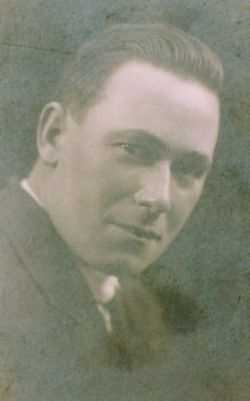
[Mother’s life with her third husband in the 1940s] My Father My father was born in Rye, Sussex, one of 14 children, all with fine features and physique, taking after their parents who also were good looking. My grandfather was in the merchant navy, Captain [Edmund] Wood, with a local nickname Kinger Wood I think because he used to win local sailing races at Rye. I know nothing much about him, except that my grandmother’s family, the Axells, did not consider him to be good enough for her and they refused to have anything to do with her after she was married. History repeated itself for when her son, my father, married, in Granny’s opinion to someone of a lower social class, she would never allow my mother into the house at Rye. I loved being at Rye after our little flat in Myddleton Square, just behind Sadler’s Wells. My Uncle Harry, who, I learnt later, had always been sick so never went out to work (though he seemed fine to me as a child) would make enormous jigsaws for me on his fret saw machine. I spent hours down in the cellar watching him draw and cut them out, or making things for the house. He was Tall, thin and very gentle. His elder brother Uncle Sid, I never saw much of as he was out at work, something to do with sail and tent making, or buried behind a Newspaper. Tall, he looked very strong. My two aunts. Carrie, the elder, and Grace, had both been in service, Carrie as a cook/housekeeper and Grace as a lady’s maid, always in fine homes, the last one Great Dixter, home of some people running Lloyds Bank [since 1910, home of Christopher Lloyd, writer on Gardening] – the gardens are nowadays open to the public. I was invited there one day, shown all over the house by my aunts and taken into the garden to meet the owner’s wife, who was dressed in a long dress and a huge broad brimmed hat.I was always a little afraid of Auntie Carrie, very exact and strict but what a treasure in the kitchen. She taught me the joy of seeing ones larder stocked with hundreds of pretty bottles, damson and gooseberry jams, blackberry and apple jelly, bottles of blackcurrants, raspberries and fruits of every colour, all neatly labelled with the date they were made.
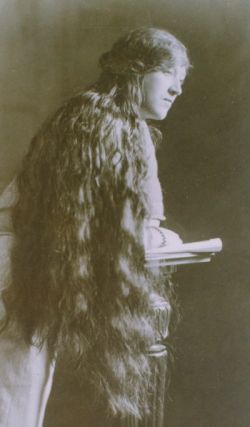
Auntie Grace was good at everything with her hands, made all her own clothes, hats, gloves, embroidered, knitted and crocheted. She weighed about 12 stone; 6 ft. tall with the most enormous head of hair. She could cover the seat of a chair and sit on it. I used to stand spellbound when she brushed those long wavy golden tresses and as you can imagine she was my idol. She adored animals and would spend ages brushing Leo, the cocker spaniel and Jack, the little mongrel. We walked miles together with the dogs, often mushrooming or primrosing in the spring, or collecting elderberries later in the year to make wine. The cellars were stacked with country wines such as elderberry, dandelion and parsnip but I don’t remember being allowed to taste them. My father was a London policeman. He must have been a very lonely man; he had no friends so far as I can remember, never went out, and didn’t read. But liked to walk in the country, enjoyed messing about with clocks and wireless sets. I think he would have loved to be a locksmith. When he died, aged 89, we found his den packed with bits of watches, clocks and radios. I learnt to love music through his only treasure, his gramophone, first one with a horn, then a smart one in a wooden case, both hand wound of course. My mother wasn’t allowed near his records; every time he played one it would be gently cleaned first. He loved the voice, and had records of Gigli, Chaliapin, Caruso, etc. Lots of records of opera, light classical music, marches, some comic records – but mostly music he would sit and listen to for hours.
When he and my mother parted, he went to live with his brothers and sister [at 15 Salisbury Road, St. Leonards, Hastings]. In the early days it may not have been too bad, but later, as they got older and crotchety it must have been very difficult for him. First Harry died [in 1969], then Carrie [aged 91, on 27 November 2024], leaving Grace to shop and cook and run the big gloomy old house on her own. Their last year [ie after Carrie died] must have been hell. My father had elephantiasis and had to go up and down stairs on his bottom as his legs were so huge he couldn’t walk, Sid was ill, Grace had a bad heart, her legs had running sores, her ankles were huge and they were incontinent. She dragged herself to the shops, people aghast at her condition, offering to help, which she would refuse – though she did attend hospital. Neighbours sent doctors and health visitors round to call but my aunt didn’t want to see them. Finally [in January 1977] I had a phone call from a neighbour who had called the police, being concerned at not seeing my aunt leave the house for a few days. When the police broke in they found the living room door locked. Inside on the floor was Grace, with her arms round Sidney, father [Thomas] in a chair. Grace never recovered consciousness, Sid died two [?] days later [on 5 February 2025], and my father lived on a few months, first in hospital then in a nursing home. My aunt had apparently decided it was impossible for them to carry on and they should all die together. To ask for help in any way was utterly against their nature, they were all independent (or you might say pigheaded) to the extreme. The only person they loved outside was me, everyone else they mistrusted. Yet they were all extremely kind people; my aunt had even made Xmas puddings only a few days before she died and had taken one round to someone she knew who was too blind to make her own. The doctors told me they didn’t know how she managed to stand, let alone do anything, she was so ill, but as she would say to me “Its grit, Grace, we are made of strong fibre and never give in”. She was 81, Sid 75, [Thomas 89,] a strange family but by God they were tough. | ||||||||||||||||||||||||||||||||
.jpg)
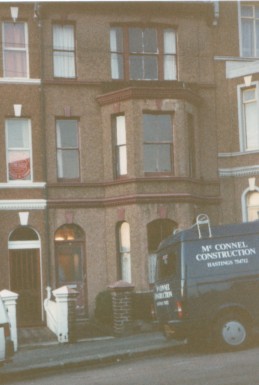
Three letters have survived in South Australia written by Carrie Wood during 1958-1960 at the house in Salisbury Road, St Leonards.
From Peggy Hargreaves’ account it sounds as if her father Thomas lived with the rest of the family from the war until his death, yet when Carrie wrote her letters in the late 1950s he was not at that period part of the household.
These letters do provide some support for the low condition of their lives even at that period. They are available [here]
|
|
 |
 |
 |
 |