View and map of Midley in 1999:

View and map of Midley in 1999:
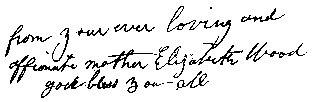
This is an account of Thomas Wood, who was born in Midley, in the Romney Marsh, Kent, in 1854. When he was a boy, aged about four, the family moved to nearby Lydd, to live in a house at the far western end of the High Street. At the age of 22 Thomas left Lydd possibly after a disagreement with his father and emigrated to South Australia, He sailed on an emigrant ship, Lochee, a free passage for 500 emigrants funded by the South Australian government, from Portsmouth on 22 November 1876, arriving 2 February 2025 at Port Adelaide.(1) He did not contact the family back in England until the beginning of 1884. By that time he was married with a little daughter. In Australia (2) has survived the following three letters written to him from Lydd.
|
|
Thomas’s younger sister Julia at Lydd added the following:
|
Dearest brother |
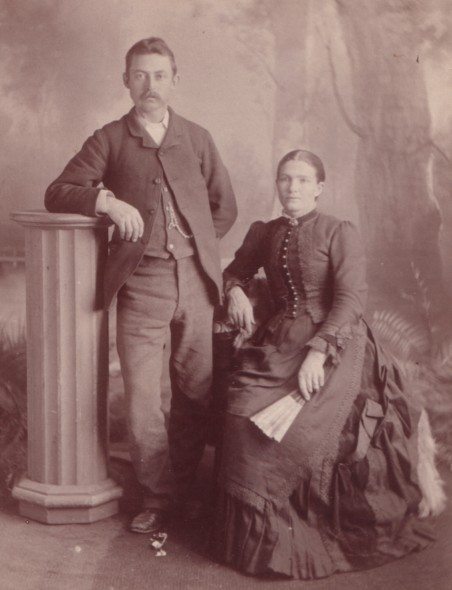
Thomas Wood (1854-1904) and wife Louisa, née Kuehn (1854-1940).
Louisa was Australian born, her parents having immigrated from Prussia in 1847.
Photograph presumably taken at the time of their marriage at Laura, South Australia, in January 1882.
|
May 1886 Your letter at hand on good friday morning. Dear brother we received your kind letter was very glad to hear from you. So glad to have your photo and your dear little girl does look such a pretty little thing /she looks so small to be the eldest/. We have shown your photo to nearly all your dear friends. Some cannot see a likeness at all your brother Harry and we all think you have altered a good deal. Is it very warm out there. Alick thinks he shall come out there this summer when the shearing is over so has to have a few pounds to go about with. He says he wont take me with him he thinks he better come and see what its like first. Mother seems so put out to think he means going she said she would rather follow him to the grave She says she knows she wont see him again on this earth. Please could you tell us a little more about the country and send alick the fare, and what station would you see him would you name the place. Mother and brothers and sisters all send their kind love to you all. We will all send our photos in a time. Your poor o dog fly is still living your old sheepdog. Alick wants to know wether he should want to bring much with him. I must now end with love from your dear old brother and sisters and all your dear o friends. Mother hopes Alick wont come. Love from mother. XXXXXXXXXXXX |
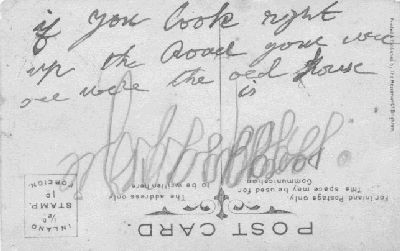
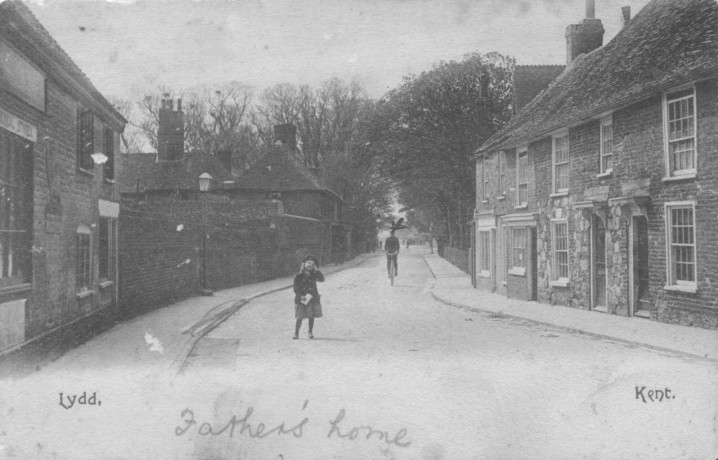
Around the same time
a postcard was sent to Thomas,
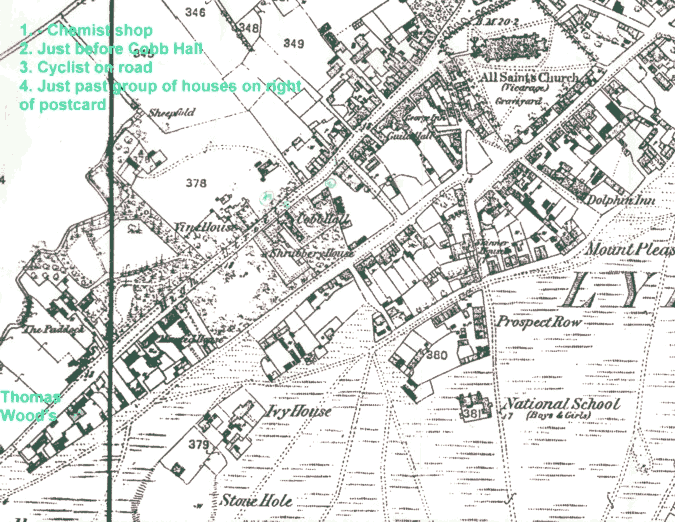
showing the west half of Lydd High Street. The old family home at the west end of the High Street, where his mother and father were still living, would have been reached on the left on walking to the far distance.
[Return to top of page] [Wood family tree from 1771]
The family Thomas left behind on the Romney Marsh were all agricultural labourers and ‘lookers’ as shepherds were called there. It might be thought, coming from the Marsh famous for its breed of sheep, that Thomas would likely be involved with sheep in Australia. But no, he worked at a brewery and hotels, and he eventually became manager and owner of the hotel at Willowie, in South Australia about 175 miles north of Adelaide, The following account of the Hotel and Thomas at Willowie appeared on pages 113-5 of Plains of Contrast, being a history of Willowie, Amyton, and Booleroo in South Australia, published by a Willowie History Book Committee in 1975 to celebrate the centenary of those South Australia Hundreds. The text from the book has been provided by Patricia Button (née Barrie), who, through his daughter Alice, is a great-granddaughter of Thomas Wood of the Willowie Hotel.
|
The Willowie Hotel. From South Australia Chronicle, “June 29, 1878, Willowie…a new public house is about to be started in this town.” This announcement was followed in March 1879, by a sale notice from W. Wadham and Co. … to sell by auction at their rooms, Waymouth Street, Adelaide. (amongst other northern hotels):- “The Willowie Hotel containing 12 large rooms. bathroom, and pantry, rainwater tank of 11,000 gallons, capacious cellars, stabling etc., built in a most superior manner and only recently completed. This Hotel is situated on the main road from Orroroo to Wilmington, fronting the three chain road, and is let on lease for seven years from January last, at a rental to Messrs Filgate and Sabine (were partners in the Laura Brewery). Also the Pinda Hotel. This is situated on the Willochra Creek, eight miles from Wilmington and on the main road, and is in every respect similar to the WilIowie Hotel. This is also let to Messrs. Filgate and Sabine at a rental of £5 per week for five years.” 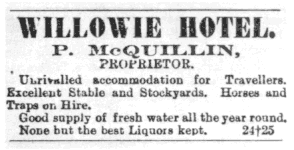
Previous to this the licence was first granted to M. Bills in I878. In 1879 the hotel licence was taken over by P. McQuillan who held it for three years before moving to the Wauraltee Hotel. Before the building of the hall in 1889 the Hotel was the scene of many early public meetings. District railway committee meetings were held in the long room in I879, 1880, and 1881. An angry confrontation took place there in 1880 with the Railway Commission. The Agricultural Society inaugural meeting took place there, and public grievances were aired at a “Wants of Willowie” meeting in August 1882, when local people met to press for a water supply, declaration of a polling place and the opening of a day school |
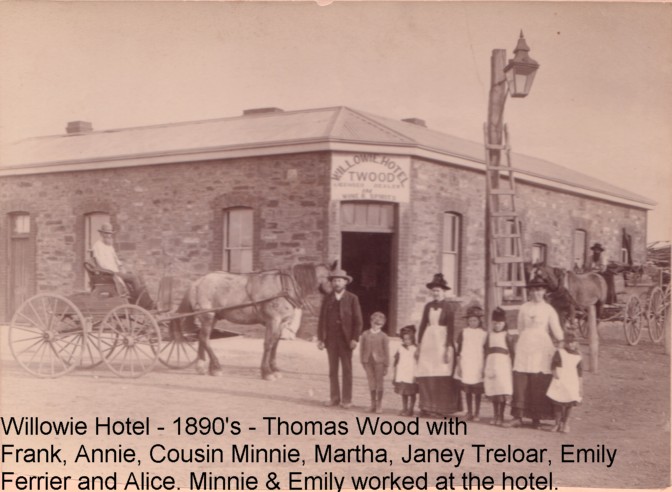
Willowie Hotel 1890s [1891?]. Family group. Left to Right. Thomas Wood with children Frank [Francis, born 1884],
Annie [born 1887]. Cousin Minnie (Alwina Kuehn), Martha [born 1882], Janey Treloar, Emily Ferrier and Alice [born 1885]
(Minnie Kuehn and Emily Ferrier worked at the hotel)
|
Personal reminiscences include the following: – |
Below is a photograph of all of Thomas and Louisa Wood’s young family taken outside the hotel at Willowie in c.1899. From left to right are Bessie (1891-1970), Frank (1884-1952), Martha (1882-1968), Alice (1885-1981), Annie (1887-1963), with the youngest, Florence (1895-1975), sitting in front. There had been one other baby in 1889 but she had not lived more than three weeks. For more information set out in the family tree about these children, their own marriages when they grew up, and their children, click [here].
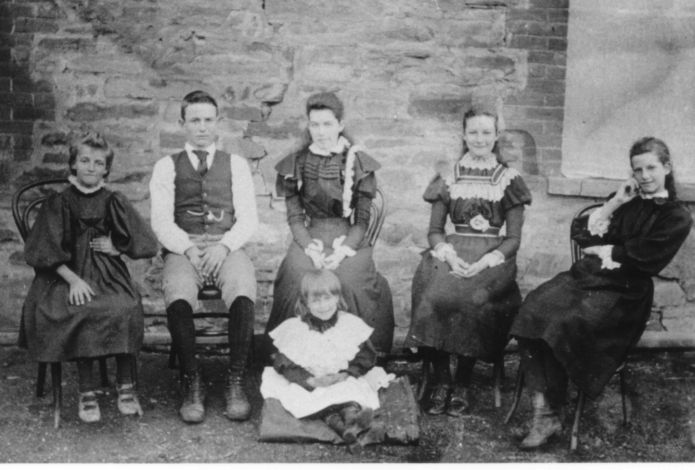
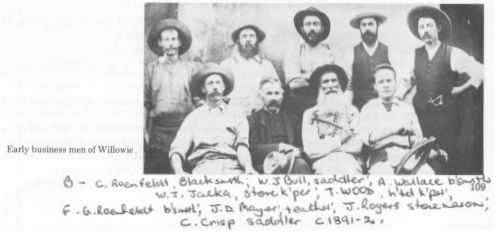
There was not a wide range of occupations that could be followed in Willowie. The picture here shows some of the most prominent men there around 1891, with Thomas Wood at the far right. In the family photograph above taken at the end of the decade it can be seen that Frank (or Francis as he was christened), the only boy in Thomas’s family, had reached an age to leave school to start work. Thomas died at an early age of 50 in 1904, only five years after that family group was photographed. Frank had started work at the Willowie general store. He was, indeed, was on the way to eventually being the owner of that other well known business in Willowie, as we can learn from the following short account on page 112 of Plains of Contrast, published in 1975:
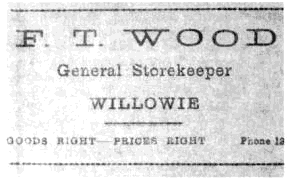
Mr Frank Wood, who spent all his working life at Willowie, married Miss Graham, a teacher at the Hundred of Willowie school, and lived in the home later to be known as Mountford’s. On becoming manager and later owner of the store he moved to the manager’s home at the store. Mr. Wood became the proprietor of the store in 1925, and for many years was the popular friend of young and old alike- helping many through the lean years and many of his sayings and stories are still related by the (today’s [mid-1970s]) middle-aged group who were children during Mr. Wood’s days at the store. 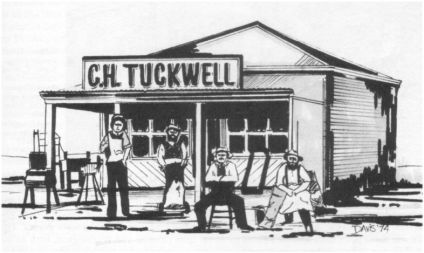
|
Today it is even possible to add here a personal memory, for although Pat Button was only 8 years old when Frank Wood died at Willowie in 1952, she can just remember him in the store there: “I used to stay with my mother’s parents (McCallum’s) for holidays on their farm and we would sometimes go into Willowie to do a little shopping. I know the shop fascinated me – full of so many different items and the smells – especially the cheese. I did not realise in those days that he was my Grandmother [Alice] Barrie’s brother.” Bill Wood (grandson of Martha Wood) attended primary school at Willowie in the 1940’s and he tells how he used to race down to the shop after school and if he was very lucky Frank would cut him a slice of cheese off the big round.
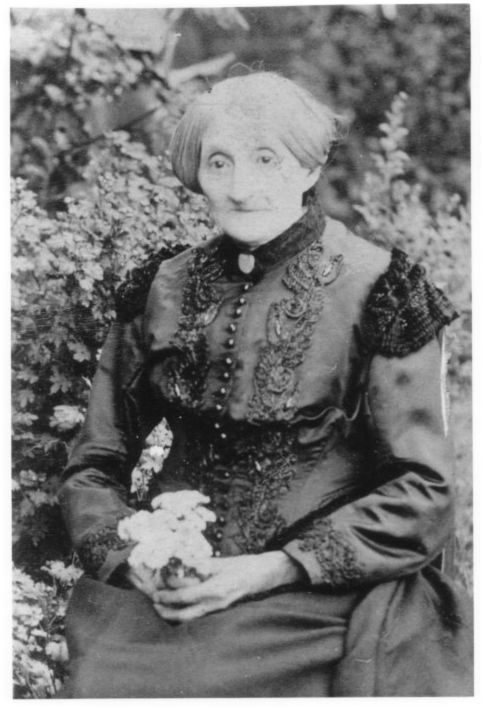
Louisa Wood, still at Willowie in the 1920s.
Yet not only is it possible to still (at the beginning of the 21st century) provide such a personal memory above of Thomas and Louisa Wood’s son and daughter at Willowie, but even Louisa herself in her 70s can be recalled. For unlike her husband she lived to a ripe old age, until 1940. So now we can have memories of Louisa while in her 70s recollected by Pat’s father, Jack Barrie and by his younger brother Kevin (sons of Alice Wood – second from the right in the children’s photo above on this page):
First, Jack recalls:
My schooldays started at the Willowie School in 1922. Because we lived over seven miles from the school we Barrie children stayed with our grandmother Wood from Sunday afternoon until Friday after school… Grandmother Wood kept a number of cows and we children had to get the cows in and help with the milking both in the morning and the evening. Mostly in the daytime the cows would be in the long paddocks – that is along the road. In those days the cows and horses could be depastured along the roads by paying the District Council a yearly fee per animal… (Granny Wood did have several acres of ground, but these blocks were mainly used for the cows at night)… This road or rather stock route was the favorite eating ground for Granny’s cows but sometimes they would head south along the Booleroo road for 3 to 4 miles. If they went north they did not go so far – perhaps a kilometer. A farmer that lived up that road had his house close to the road and had a dog or dogs that would not allow any stock to go past his gate … Occasionally big herds of cattle used to travel along this stock route and from one of these herds one wild station cow somehow got left behind and she palled up with granny’s cows. This cow would charge anyone on sight and had everyone in Willowie frightened of her bar granny. Granny would go for the cow with a long handled shovel or broom and drive it off.
When granny Wood told us to do something it had to be done at once. If we grandchildren dawdled or did not do things correctly she would chase us and catch us then off would come one of her shoes – she wore men’s tennis shoes and our backside would really feel the sole of her shoes.
For my last four years at Willowie School Mr Cliff Selway was my teacher. He and his wife arrived in Willowie some time before their furniture and so for the first two or three weeks they boarded with Granny Wood. Two or three weeks after they had settled into the school house it was very hot and we were all outside at Granny Wood’s when there was a terrific crash and clouds of dust came out the bedroom they had been sleeping in at Granny Wood’s house – the whole ceiling of the room had come down smashing the bedroom furniture. The ceiling was what was known as a lathe and plaster ceiling and with the accumulation of about fifty years of dust it would have been a great weight. The only way into the room after the event was through the window until the debris could be cleared away from the door. A large tomcat was found in the room after the crash and it was presumed that his weight must have triggered the ceiling to fall. Cats were able to get up into the ceiling of the old hotel, too. Thank God that no one was in the room when the crash happened.
Sometime in the middle 1920’s granny Wood took ill and was taken to Adelaide to Dr. Bowman who diagnosed her case incurable and gave her at the most six months to live. When she came home she went straight back to the cow yard and milked at least one cow every morning right up to within a few days of her death in 1940. What Dr. Bowman thought her complaint to be I was never told. As long as I knew her and lived with her I never knew her to sit at the table and have a proper meal with the rest of us. Christmas and other special events were the only exceptions to her eating habits that I remember. For the most part she lived on tea and an odd slice of bread and butter. Although the rest of us made tea in a teapot for our meals, granny always had a cup of tea stewing on the edge of the stove. Periodically throughout the day she would take her cup off the stove, pour the tea into a saucer to cool it and then drink it. When the cup was nearly empty of liquid she would add more tea leaves, fill with hot water and milk, and put it back on the edge of the stove until next time. She did this from early in the morning. She was usually the first up and only went to bed at 10 or 11 pm. Perhaps the tannin from the stewed tea made her immune to whatever illness she was supposed to have had. She always had sugar in her tea – perhaps this gave her energy, and she also had milk – fresh full cream milk.
Next, Kevin’s memories of Willowie, his grandmother Wood and Aunt Florence:
In 1927 at the age of six, I started school at Willowie. Living over seven miles from town it was too far to travel each day, and we stayed with Granny Wood and Aunt Flo who resided in the old hotel, going home for weekends and school holidays. Aunt Flo [Thomas and Louisa (Granny) Wood’s youngest daughter Florence, born 1895] helped her brother Frank in his store, including the bookwork and savings bank agency. She was meticulous in almost everything she did including handwriting, the opposite to Uncle Franks whose awkward backhand was a form of art in its self and to the untrained mostly illegible.
All the bedrooms except two in the old pub were unsafe to use, and I had no option for the early years at school but to share Aunt Flo’s double bed, and in the same room with grandma. I was too young to suffer humiliation to any extent, but was more than pleased when Lance went to live at John Duffield’s and only came occasionally, and so I could use his room.
Memories of my 6 years at Granny Wood’s are not ones I can enthuse about, and the older I grow the less affection I can find for her. She was really a martinet and never knew the meaning of affection, leave alone love. Her idea of thanks for something done well was to say nothing. If displeased, her reward would be a cuff under the ears and sent to bed, or if it was too early, an extra turn with the axe to build up the wood supply. Didn’t see very much of Aunt Flo, after helping with the preparation of a morning she would go over to the shop and it would be often 9 o’clock of an evening before she would come home unless she had to cook tea, or went back after tea to help Uncle Frank with egg packing and doing the books.
I knew where Gran kept a revolver, Grandpa Wood probably used to protect the bar at the pub … I often wonder what happened to the old revolver, probably buried down the cellar with other items that would have been historical relics when the pub was demolished to make way for Aunt. Flos house built in the mid to late 1930’s.
It was at Willowie I learned that the cow is the most despicable of all farm animals. Gran and Uncle Frank kept a number between them varying from about 4 to 8 and it was the job of the Woods girls and the Barries to milk them. During school days, it was also my job to either bring them in from the town blocks if there was any feed in them, or most of the time from the roads where they wandered in search of pickings. And wandered they did. Aunt Flo would tell me when I came out of school which road they started off on and it was then up to me to track them up. Usually they could be found on the flood flats south of the town or visible on the plains on the other three roads. Occasionally though they would really get the wanders, and one night I will never forget. It was mid winter and almost dark when I finally tracked them on a side road about 6 miles south west of the town in the vicinity of Jack Schmidts place. It was freezing cold and Queenie the pony I was riding was in as much of a hurry to get home as I was. To say that we walked the cows back would be a lie they were cantering rather than trotting much of the way and of course were to upset to produce much milk. Old Gran really went to town on me, but at the time I thought she was dam lucky to even have the cows, leave alone any milk. I had contemplated giving up searching for them altogether, and by next day they would probably have found their way to Wilmington or Melrose.
Morning milking was a bugbear. The cows would be kept in the yard over night and before going into the bails would have to be run around a bit to stop them urinating or plopping into the buckets while we were milking. Sometimes it worked, more often it didn’t. Winter mornings were the worse when the water in the yard troughs were often frozen and our hands were sore and covered in chillblains. I often wonder if cows suffer from chillblains, on their teats, as they always seem to be harder to milk in the winter than in the summer, requiring leg roping in the bails. And many the smack in the eye we had from switching, spear grass seedy stinking tails. Who could love a cow!
Perhaps we did have an occasional spot of fun. Trying to ride the poddy calves around the yard was a bit of a giggle with no bridle or mane to hang onto as to a horse. The cows were too bony but were probably much quieter. Milk spurting fights were not uncommon but woe betide if Granny caught us.
Glenda & Valerie Wood, and Jack White the postmaster’s son were all around our age and sometimes we would have time after our jobs were done to get up to some form of mischief or a game of rounders.
Other memories of Willowie:
include travelling mobs of cattle coming in from the north and being watered and yarded overnight in blocks Gran owned on the Southern side of the town.
Of the dreaded spoonful of paraffin oil or caster oil dished out by Aunt Flo and Gran when we feeling indisposed. Would go through hell rather than be ill enough to suffer that treatment. Yet Gran used to have a spoonful every morning to keep fit.
Of turning the handle of the wrangle used to press the linen on washdays. How I hated the job.
Of Grans habit of pouring out endless cups of tea after breakfast each morning and storing them in the oven for consumption throughout the day. Whether she did drink them or not 1 don’t know. I seem to recollect we tossed out cup after cup of brown stained cups of milk tea come wash up time of an evening.
Of Grans setting off with a lantern after dark and rounding up the broody chooks and feeding cows or poking about doing who knows what, and never going to bed much before midnight and of her hanging up chooks by the legs to stop them going clucky.
Of the Christmas dinners either at home or at Grans. When the full Brown, Bull and Barrie family, as well as Aunty Flo and Gran would assemble for the hot Xmas chook for lunch, regardless of the temperature. Often wondered why we never went to Bull’s or Browns, but now realise they had cars, but their kitchens were small and they had no dining table big enough to take us all. There would have been 16 or 17 of us to find seats for.
1. This is not the place to set out a detailed account and discussion of the emigration process in England and particulars of the voyage and passenger list of the Lochee, but the sources are South Australian Register (Adelaide) 22 January 1877, pp. 5g-6b being a report on the facilities provided both for emigrants at Portsmouth and on the Lochee; South Australian Register (Adelaide), Saturday 3 February 1877, p. 1b has a full passenger list of the ship on arrival at Port Adelaide with statistics about the range of occupations, and a cargo list; South Australian Register (Adelaide), 7 February 1877, p. 4d, delivers a critical editorial on the South Australian Government’s policy for providing free immigration with regard to the local “capitalist’s standpoint” as “it would seem as though the funds of the colony are being spent in an experiment to relieve the English Poor Law of a portion of its burdens”. That editorial (and an earlier one in The Observer (Adelaide) 3 February 1877, p. 4) also centres on the fact that 21 children and 5 adults died during the voyage of the Lochee (the doctor in charge reporting that “a number of immigrants came on board in a very weak state from insufficient food, as many of them had been for months out of employment”); The Times (London), 11 April 1877, pp. 5d-6a, printed a most interesting and very relevant long report by Henry Taylor, Emigration Commissioner of the National Agricultural Labourers’ Union in England, who, at the time Thomas Wood arrived, had spent six months in South Australia investigating the conditions, prospects and problems there for emigrants.
2. The letters and postcard from Lydd, and most of the family photographs, passed first to Jean Barrie (daughter of Thomas’s Alice (1885-1981)) and then to her daughter Judith Lloyd in Adelaide.
 |
 |
 |
 |
 My dearest son,